
Why your automated outreach feels like spam (and how to fix it)

If you get them, you know your audience also gets them… Every week, dozens of emails hit inboxes looking like this:
"Hi [First_Name], I noticed you’re the [Job_Title] at [Company]. We help [Industry] leaders scale revenue by 300% using AI-driven synergies..."
Delete. Mark as spam. Block domain.
I know I have ranted on this before on LinkedIn… a few times… I promise, it’s not a “get off my lawn” situation. It’s just frustrating to see people waste money on lazy marketing.
Cold email outreach isn’t dead, but lazy automation is. Most automated sales systems fail because they treat automation as a way to send more messages rather than better ones. When you prioritize volume over relevance and value, your strategy becomes indistinguishable from spam.
Here is why your automated outreach feels robotic – and how to fix it before your reputation takes a nose-dive.
The 4 reasons your outreach feels like spam
"Fake personalization" is easy to spot: Inserting {{FirstName}} and {{CompanyName}} no longer fools anyone. When the rest of the email reads like a generic template, slotting in a company name just highlights that the message was generated by a machine. Even worse when the fields don’t populate and you send with that inserted text.
You’re pitching on step one: Asking a complete stranger for a 30-minute discovery call in your very first message is the digital equivalent of asking someone to marry you on a first date. It signals that you care about your sales target, not their actual problem.
Irrelevant targeting: Sending a generic message to 5,000 broad contacts guarantees a fraction of a percent response rate. If your value proposition doesn’t align specifically with the recipient's immediate pain points, it’s spam to them.
Robotic tone and formatting: Overly formal jargon, bulleted lists of features, and multiple tracking links trigger both psychological alarms for the reader and technical spam filters for email providers.
How to fix your automation
Fixing your outreach doesn't mean ditching automation – it means automating the right parts of the process.
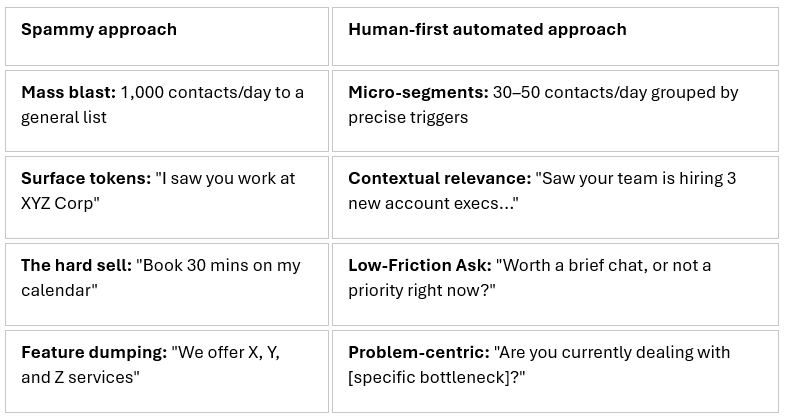
The 3-step framework for human outreach at scale
Segment by trigger, not just job title: Set up automation that flags real events – like a recent fundraise, a new executive hire, or job postings for specific roles. Build your outreach campaigns around these specific triggers.
Lower the barriers for a reply: Swap "Can we jump on a call next Tuesday?" for soft, interest-based calls to action. Try: "Are you open to seeing how we solved this for [Competitor]?"
Warm up and protect your technical setup: Use dedicated secondary domains, strictly limit daily send limits per inbox (30–50 max), and ensure your SPF, DKIM, and DMARC records are properly configured.
Automation should amplify your relevance and the value you bring to the table, not your volume. By scaling actual research and adopting a low-friction approach, you can turn generic cold emails into genuine, high-converting conversations.
Wondering how to get started? Book a free, no-strings-attached call with me!